





Neapolitan coffee: the cuccumella, caffè sospeso and the blends of Naples
A cup with rules of its own
We have been selling coffee for more than fifteen years, and when a customer asks us for "a blend that tastes like Naples" we know they are not talking about flavour alone. They mean a way of preparing, serving and drinking coffee that the city has shaped over time and that you recognise at the first sip.
In this guide we look at what makes Neapolitan coffee different: the pot that is turned upside down, the custom of the caffè sospeso, the scalding cup with a glass of water beside it, and the style of the blends roasted in Campania.
We have already written about the espresso machine and its history elsewhere. This post is about the city, its habits, and how to bring a piece of them into your kitchen, with the pot or the capsules you already use.
The cuccumella and the moka: two ways of moving water
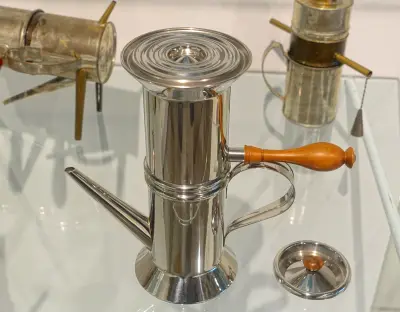
The Neapolitan coffee pot, known in Naples as the cuccumella, has a surprising origin: it was patented in Paris in 1819 by the Frenchman Jean-Louis Morize. Naples adopted it, made it first in copper and later in aluminium, and turned it into a household object.
It works without any pressure. Two containers are stacked with the coffee filter in between: water is heated in the lower one, once it boils the pot is taken off the heat and flipped over, and the water passes through the ground coffee by gravity, dripping slowly into the container with the spout.
That slowness is the main difference from the moka, which pushes water upwards with steam pressure and is much faster. The cuccumella usually gives a lighter, rounder cup with no crema; the moka a more concentrated, assertive coffee.
Tradition adds a detail that is entirely Neapolitan, the cuppetiello: a small paper cone placed over the spout while the coffee drips, to hold in the aroma. Eduardo De Filippo built a famous scene around it in "Questi fantasmi", a comedy from 1946. In the late 1970s the Neapolitan architect Riccardo Dalisi redesigned the cuccumella for Alessi, and in 1981 the work earned him the Compasso d'Oro.
Since the mid-twentieth century the moka, faster and simpler, has replaced the Neapolitan pot in most kitchens. Both start from the same point: good coffee beans or ground coffee, ground a little coarser for the cuccumella.
Caffè sospeso: one more for whoever comes next
The best-known custom of the Neapolitan bar is the caffè sospeso, the "suspended coffee": someone in a good mood, or with something to celebrate, orders two coffees and drinks one. The second stays "suspended" at the counter, and later a person who needs it asks whether there is a sospeso and receives it.
There are no precise records of its origin. The writer Riccardo Pazzaglia traced it to groups of friends at the counter: in the confusion over who was treating the others, a coffee would sometimes be left paid for and not drunk, and over time that extra coffee became a deliberate gesture.
In recent years the tradition has become visible again. Luciano De Crescenzo devoted a book to it in 2008, and since 2011 the Caffè Sospeso Day has been held every 10 December, promoted by a network of cafés and associations. The idea has travelled beyond the city and now has versions in several countries.
A scalding cup, water first and the three Cs
In Naples a well-made coffee follows the "three Cs": caldo, comodo and carico, that is hot, unhurried and strong. Hot because the cup is served scalding, so the coffee loses neither temperature nor aroma. Unhurried because it is drunk calmly, even though it is short. Strong because the blend must have body and the cup must be dense.
A glass of water almost always arrives with the cup, and here Neapolitans have a firm rule: the water is drunk before the coffee, to clean the palate, and not after. The habit exists in other Italian cities too, but in Naples it is close to a ritual.
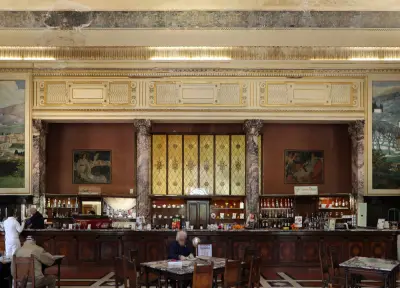
Coffee at a Neapolitan bar is usually short and very hot. It is often drunk standing at the counter, but without rushing: calm is part of the rules.
To get close to this result at home, two small steps are enough: warm the cup with hot water before extracting the coffee, and take a sip of water before the cup, not after.
The style of Neapolitan blends
The Neapolitan school also has a recognisable taste. Traditional blends are usually roasted dark, sometimes very dark, and often contain a share of robusta alongside arabica. In the cup this gives a full-bodied espresso with a thick, lasting crema, low acidity and a long, slightly bitter finish.
That share of robusta is not a shortcut. In a Neapolitan bar blend it is there precisely to provide body, crema and staying power, so that the coffee holds up to a scalding cup and to sugar without losing character. Arabica brings sweetness and finer aromas.
It is a style, not a ranking. Those who love light roasts or livelier acidity will find their coffee elsewhere, and rightly so. Those looking for "bar coffee" as Naples understands it, dense and assertive, will find the most faithful answer in these blends.
A useful clue on the packaging: the words "napoletano", "tostatura scura" or "extra scura" almost always point to this profile. To understand how the roast level changes the taste, we have written a guide to roast levels.
Campanian roasters in our range and how to bring them home
Many of the roasters we sell every day work right in Campania, and it shows in the cup. Kimbo is from Naples and names its blends after places in the region, with profiles ranging from the darkest to the softest. Passalacqua has roasted in Naples since 1948 with a slow, indirect-heat method and gives each blend a name of its own.
Caffè Borbone, a Campanian roaster, has turned the colours of its packs into a language: to find your way among Rossa, Blu, Nera, Oro and Dek we have written a guide to the Borbone blends. Toraldo brings Neapolitan espresso to almost every system, and among the Neapolitan roasters you will also find Lollo Caffè, Izzo Caffè and Zito Caffè.
The format depends on how you make your coffee. For the cuccumella and the moka you need ground coffee or beans ground just before brewing. Pod machines take Neapolitan blends in ESE 44 mm pods; capsule machines find them among the Nespresso® compatible capsules and those for Lavazza A Modo Mio®, Nescafé Dolce Gusto® and other systems.
If you are not sure which blend to start with, or want to know which one comes closest to the coffee you drank in Naples, contact us: the Maracatú team will be glad to help.
Popular products
All products
More


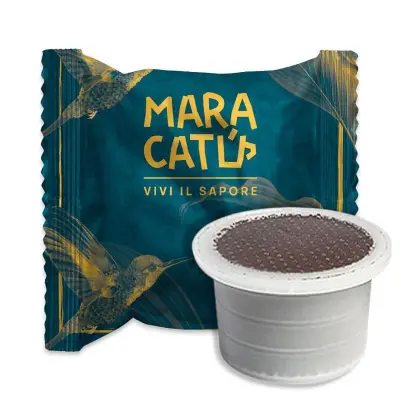 100 Maracatú Coffee Capsules Gran Crema Uno System Compatible
19,90 €


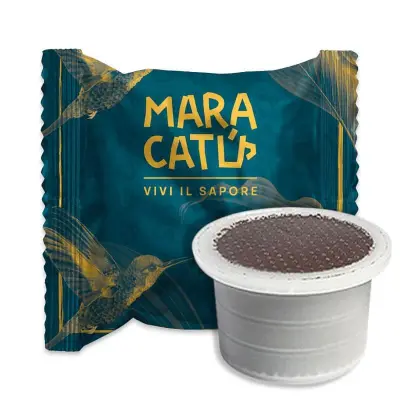 100 Capsules Maracatú Decaffeinated Uno System Compatible
23,90 €
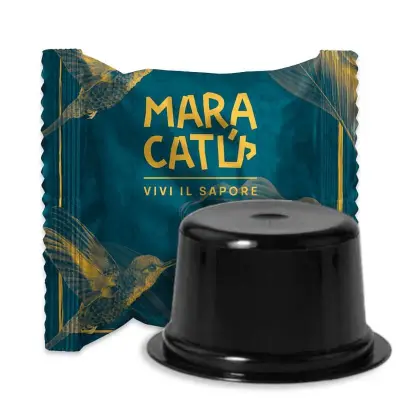 80 Maracatú Coffee Capsules Gran Crema Lavazza Blue In Black Compatible
18,90 €
More on this topic
More

Coffee Capsules Guide: How to Choose Your Perfect Taste
Read article


5 myths about capsule coffee
Read article
How to properly store coffee and coffee capsules: expert advice
Read article

Are you a reseller? Access the Maracatú B2B price list in just a few steps!
Read article
Capsule systems compared: Nespresso, Dolce Gusto, A Modo Mio, ESE and Caffitaly — which to choose
Read article

How to descale your coffee machine: a practical guide from over 15 years in coffee
Read article
Caffè Borbone: a guide to the Rossa, Nera, Blu, Oro and Dek blends
Read article
The coffee intensity scale: what the numbers on capsules really mean
Read article
The origins of coffee: myths, legends and the road to the Italian cup
Read article
Coffee roasting: the levels, and how each one changes the cup
Read article
Espresso: how the Italian classic was born
Read article

Water and the taste of coffee: the ingredient nobody talks about
Read article