






The coffee intensity scale: what the numbers on capsules really mean
The number everyone looks at and almost nobody knows how to read
On almost every pack of capsules or pods there is a number, often next to a coloured bar: intensity 5, intensity 9, intensity 12. It is one of the first things customers look at and, in our experience, also the one that raises the most questions.
Let us start with the most important point: intensity is not an official measurement and no standard defines it. It is an indication each roaster uses within its own range to summarise how full-bodied, structured and persistent a blend is in the cup compared with the others from the same brand.
Put simply, the number describes the character of the coffee, not its strength in a chemical sense. In this guide we explain what intensity really depends on, what it does not mean, and how to use it to choose the blend that suits your taste.
Intensity does not mean more caffeine
This is one of the most widespread misunderstandings and one of the questions we are asked most often: "I'll pick intensity 12 so it wakes me up better." In reality, intensity and caffeine content are two completely different things.
Perceived intensity depends above all on taste: body, bitterness, roasted notes and aromatic persistence. The amount of caffeine in the cup, by contrast, is influenced by other factors, in particular the composition of the blend and the amount of coffee extracted. A long coffee, for example, generally tends to contain more caffeine than a ristretto made from the same blend, simply because more liquid is extracted — even though it can taste more delicate.
The variety matters too: Robusta generally contains more caffeine than Arabica and is also the variety that gives more body, a denser crema and that slightly more bitter taste typical of Italian espresso. This is why the more intense blends often contain a higher share of Robusta, although it is not an absolute rule: every roaster develops its own recipes differently.
If you are looking for a cup with less caffeine, the answer is not to choose a lower intensity but to move towards decaffeinated coffee, today available for most systems. The quality of decaf has improved considerably in recent years and many customers are pleasantly surprised by the result in the cup.
What really determines intensity
The intensity of a coffee depends mainly on four factors.
The blend. The share of Robusta relative to Arabica is what influences the final result most: more Robusta generally means more body, a denser crema and a more decisive taste. Arabica-led blends, by contrast, are usually more aromatic, with livelier acidity and natural sweetness. Both are available in capsules and in pods, as well as in ground coffee and whole beans.
The roast. A darker roast brings out notes of cocoa, wood and dried fruit, reduces acidity and gives that sense of greater structure many people associate with intensity. A lighter roast preserves floral and fruity aromas better and offers a more delicate aromatic profile, while keeping the quality of the blend high.
Dose and grind. Inside a capsule the dose is set by the manufacturer and can vary from one system to another. The grind also plays a fundamental role, because it determines the resistance the water meets during extraction. Both factors significantly affect the structure of the coffee in the cup.
Extraction. This is the part that depends directly on how the coffee is prepared. The same capsule pulled at 25 ml or at 60 ml gives two very different results. If a blend seems too intense to you, before changing it try increasing the volume slightly. If it comes across as too delicate, try pulling a shorter cup. It is one of the simplest and most immediate ways to adapt the result to your taste.
Why scales from different brands cannot be compared
This is one of the most frequent doubts. Every roaster builds its intensity scale exclusively in relation to its own range. That is why intensity 8 from one brand can be fuller-bodied than intensity 10 from another: it does not mean one of the two is wrong, simply that each producer uses different criteria.
The length of the scale varies between brands too: some companies use a scale from 1 to 10, others go up to 12 or even 13. That is the case, for example, with Borbone, Lavazza, Kimbo and illy, each describing its blends by its own criteria. For that reason it only makes sense to compare intensity levels within the same range.
The advice we always give is to use the number as a reference point within a brand you already know, and when you try a different producer, pay more attention to the description of the blend — Arabica or Robusta led, roast level and aromatic notes — than to the number printed on the pack. The same principle applies to compatible capsules, ESE pods and whole beans.
How to choose the intensity level that suits you
Here are a few simple pointers we often share with our customers.
If you love a short espresso and want an intense, full-bodied cup, look towards the medium-high part of the intensity scale of the brand you have chosen. That is generally where the blends with the most body and the densest crema sit.
If you prefer a long coffee or drink it with milk, a medium-high intensity keeps a good balance of flavour even after dilution, so the coffee does not lose its character.
If you drink several cups during the day, it can be a good idea to choose a slightly less intense blend. Heavily structured coffees are enjoyable, but over time they can be more demanding on the palate.
If instead you particularly appreciate floral, fruity or citrus aromas, look towards Arabica-led blends and lower intensity levels.
Finally, if tastes differ at home, the most practical solution is to keep two blends available: one more intense and one more balanced. That way it is easy to satisfy the whole family, whatever the system in use — A Modo Mio®, Dolce Gusto®, Caffitaly® or Nespresso®.
The small things that influence intensity in the cup
Before putting a difference in taste down to the blend, it is worth checking a few things. In our experience these are the same points that resolve most of the cases where a customer tells us: "It is not like it used to be."
The water. It makes up around 98% of the drink. Particularly hard water can dull the aromas and, over time, encourage limescale to build up inside the machine. Regular use of a filter or a dedicated descaler helps keep the machine efficient and preserves the quality of the coffee.
The cup. A thick, pre-warmed cup holds the temperature better and helps preserve the crema. A cold cup does the opposite: it cools the coffee quickly, altering how the taste comes across and making it seem less intense.
Storage. Capsules and pods are designed to protect the aroma as well as possible. Ground coffee and whole beans, on the other hand, tend to lose their aromatic character more quickly once opened. They are best kept in an airtight container, away from light, heat and humidity, and out of the fridge.
If you are unsure which intensity level or which blend to choose for your machine, contact us: the Maracatú team is always available to help you find the solution that best matches your taste.
Popular products
All products
More


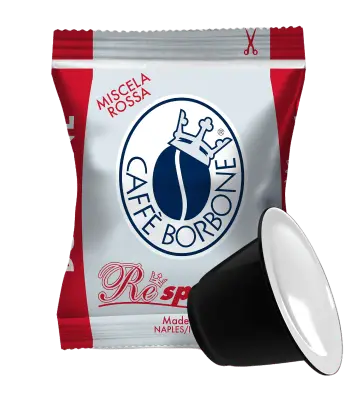 100 Capsules BORBONE Respresso RED Blend Nespresso Compatible
21,90 €


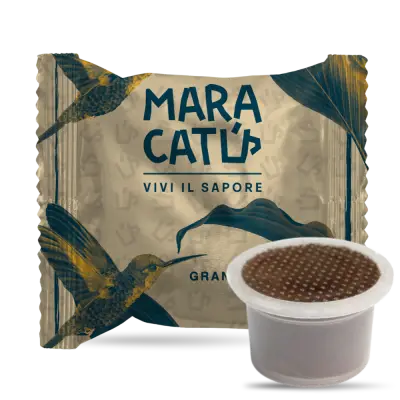 100 Maracatú Coffee Capsules Gran Crema Uno System Compatible
19,90 €
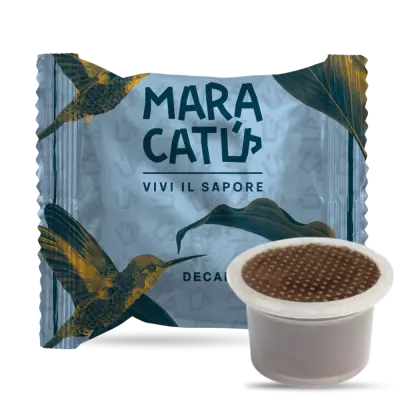 100 Capsules Maracatú Decaffeinated Uno System Compatible
23,90 €
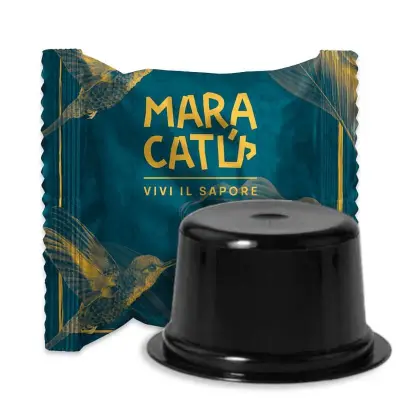 80 Maracatú Coffee Capsules Gran Crema Lavazza Blue In Black Compatible
18,90 €
More on this topic
More

Coffee Capsules Guide: How to Choose Your Perfect Taste
Read article


5 myths about capsule coffee
Read article
How to properly store coffee and coffee capsules: expert advice
Read article

How to descale your coffee machine: a practical guide from over 15 years in coffee
Read article

Capsule systems compared: Nespresso, Dolce Gusto, A Modo Mio, ESE and Caffitaly — which to choose
Read article
Caffè Borbone: a guide to the Rossa, Nera, Blu, Oro and Dek blends
Read article

Are you a reseller? Access the Maracatú B2B price list in just a few steps!
Read article

The origins of coffee: myths, legends and the road to the Italian cup
Read article
Coffee roasting: the levels, and how each one changes the cup
Read article
Espresso: how the Italian classic was born
Read article

Water and the taste of coffee: the ingredient nobody talks about
Read article
Coffee grind size: how to choose the right one
Read article