





Coffee culture in Ethiopia: the cradle of coffee
Coffee as an invitation
Ethiopia is called the cradle of coffee, and the plant still grows wild in the forests of its highlands. The stories of the bean's discovery are in our article on the origins of coffee, myths and legends: here we look at how coffee is lived in Ethiopia today, in homes and courtyards.
In Amharic, coffee is called bunna. The word names the drink, but also the time that surrounds it.
Ethiopian coffee is generally not drunk alone, nor in a hurry. It is prepared in front of the guests, from green bean to cup, and the whole sequence can fill a good part of an afternoon.
An invitation to bunna is a welcome into the house. So the ceremony accompanies visits, family celebrations and often difficult conversations, when two neighbours have something to settle.
A local proverb says that coffee is our bread. That is enough to understand how much the ritual belongs to everyday life, rather than a show staged for visitors.
The bunna ceremony: fresh grass, smoke and the jebena
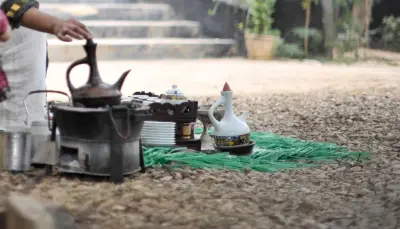
The scene begins before the coffee. Fresh grass is spread on the floor and incense is lit in a small burner: the resinous scent fills the room and announces that something is coming.
The ritual is almost always led by a woman of the house, often in the traditional white dress. She washes the green beans, tips them onto a flat iron pan and roasts them over the embers, never letting the pan rest.
The colour changes slowly, from green to yellow to brown. The beans crackle, and a sweet smoke that smells of toasted bread rises. Then the pan is carried among the guests, who wave the smoke towards their faces to take in the aroma.
Why that scent changes with heat is explained in our article on roasting and its levels. Here it is enough to say that Ethiopian coffee is generally roasted fairly dark, and only minutes before drinking.
The beans, still warm, are crushed in a wooden mortar with a long, heavy pestle. The powder goes into the jebena, a clay pot with a round belly and a narrow neck, filled with water and set back on the embers.
When the coffee rises and is about to boil over, the jebena is taken off the fire and left to rest. Then it is poured from a height, in a thin unbroken stream, into small handleless cups on a tray.
Abol, tona, baraka: the three rounds
From the same grounds come three coffees, one after the other. The first round is called abol and is the strongest. The second, tona, comes from adding water to the jebena and is lighter. The third is baraka, and the word means blessing.
Each round has its own pace. Between cups people talk, eat a little and wait for the jebena to boil again.
On the tray there is often popcorn, roasted barley or bread. Sugar is the most common addition, but in some regions people prefer a pinch of salt, a little butter or a leaf of rue, a herb with an intense scent.
Leaving after the first round can be read as impolite. Staying until the baraka is how one returns the hospitality and accepts the blessing that closes the gathering.
In many families the ritual is repeated several times a day: the morning bunna opens the day, the afternoon one gathers the neighbours. It is an invitation that never needs to be spoken aloud.
Yirgacheffe, Sidamo, Harrar: three regional profiles
Ethiopia does not produce a single coffee. The growing areas are many, and the name on the sack already says a great deal about the cup.
Yirgacheffe, in the south, is perhaps the most familiar name. Its coffees, often washed, have a light body that recalls tea, floral notes of jasmine and a hint of citrus. Anyone used to traditional espresso is usually surprised.
Sidamo is a wider area in the same part of the country. Its coffees are generally rounder, with a sweetness of ripe fruit and a gentle acidity.
Harrar, in the east, tells a different story. Here the beans are often processed by the natural method, dried with the fruit pulp still on, and the result is a fuller coffee, with notes of berries, cocoa and at times a memory of wine.
How these differences take shape between plant and sack is told in our article on the coffee supply chain from producer to cup. For the buyer one thing matters: an Ethiopian origin, on its own or in a blend, almost always brings fragrance and freshness.
Among our coffee beans and ground coffee you will find options in which Ethiopian Arabica provides the aromatic note. If you love fragrant coffees, it is a good place to start.
What to bring home from the bunna
You do not need a jebena to learn something from the Ethiopian ritual. The first lesson is slowness: in Ethiopia coffee is time given to others, and even a moka pot on the stove can become that, if it is waited for together.
The second is the scent of freshness. We do not roast beans at home, but we can grind them just before brewing, and the kitchen smells different at once.
Then there is the gesture of offering. Making coffee for whoever comes through the door, without asking, is a habit Italy knows well. In Ethiopia it is simply more explicit.
Objects matter too. The small handleless Ethiopian cups closely resemble the Italian tazzina, and a tray with several cups ready changes the atmosphere of a visit. Our accessories and cups section has cups and trays for serving several people.
That leaves the three rounds. Nobody asks you to drink three coffees in a row, but staying at the table after the first cup, and filling a second to carry on the conversation, is perhaps the most precious part of the bunna.
If you would like to try an Ethiopian origin or put together a small set for serving guests, get in touch: the Maracatú team will gladly help you choose coffee and accessories to suit your habits.
Popular products
All products
More


 100 Maracatú Coffee Capsules Gran Crema Uno System Compatible
19,90 €


 100 Capsules Maracatú Decaffeinated Uno System Compatible
23,90 €
 80 Maracatú Coffee Capsules Gran Crema Lavazza Blue In Black Compatible
18,90 €


More on this topic
More

Coffee Capsules Guide: How to Choose Your Perfect Taste
Read article


5 myths about capsule coffee
Read article
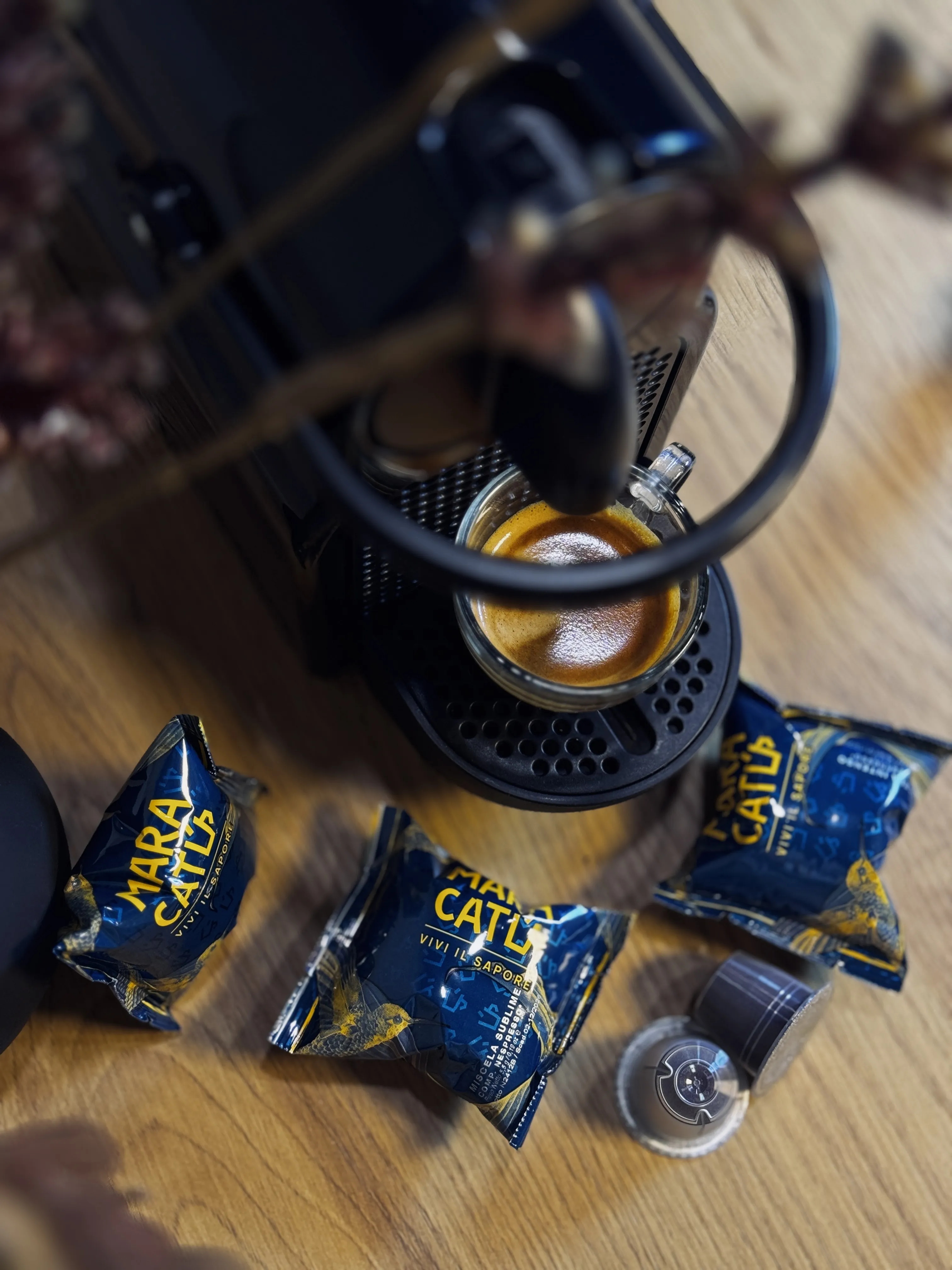
How to properly store coffee and coffee capsules: expert advice
Read article

How to descale your coffee machine: a practical guide from over 15 years in coffee
Read article
Capsule systems compared: Nespresso, Dolce Gusto, A Modo Mio, ESE and Caffitaly — which to choose
Read article
Caffè Borbone: a guide to the Rossa, Nera, Blu, Oro and Dek blends
Read article

The coffee intensity scale: what the numbers on capsules really mean
Read article

Are you a reseller? Access the Maracatú B2B price list in just a few steps!
Read article
The origins of coffee: myths, legends and the road to the Italian cup
Read article
Coffee roasting: the levels, and how each one changes the cup
Read article
Espresso: how the Italian classic was born
Read article

Water and the taste of coffee: the ingredient nobody talks about
Read article