


Lavazza Espresso Point, Firma and Blue: a guide to the professional systems
Three Lavazza systems created for offices and venues
The coffee machine at the end of the office corridor, the one in the waiting room of a practice, the one behind the counter of a small café: we use them every day, often without knowing exactly what they are called.
Then the moment comes to reorder the capsules, or the machine is passed on to us, and the doubt arises: which are the right ones?
The question is less trivial than it seems. Lavazza, the long-established roaster from Turin, in fact offers more than one capsule system, and each uses a different format.
Among those designed above all for offices, communities and venues we find Espresso Point, Firma and Blue.
Over time they have also found a place in many homes, because they are simple to use: a capsule, a button and the espresso is ready.
In this guide we look at what distinguishes the three systems, why the capsules cannot be swapped and how to recognise the machine in front of you.
We will also see what to look at when choosing capsules and how to organise coffee in an office or a small venue.
If instead you are looking for an overview of the systems most common at home, you can read our comparison of capsule systems.
Espresso Point, Firma and Blue: what sets them apart
Espresso Point, Firma and Blue share the same basic idea: a single-serve capsule, a dedicated machine and an espresso ready in a few moments.
Inside the capsule there is a ready dose of ground coffee, through which the machine passes hot water under pressure.
Dose and grind are set by the producer: this is why the result tends to be consistent, whoever makes the coffee.
They are often called professional systems because they were created for places where many coffees are made each day and the machine is used by several people.
Each system, however, has its own capsule and its own machines. Let us look at them one at a time:
Espresso Point is a system created for the office that has been around for many years. In our range you will find both the original Lavazza capsules and compatible ones from various roasters.
Firma is designed for the rhythm of the office and of waiting rooms. In the category you will find capsules for the Firma system, including ones from Italian roasters.
Blue is designed for offices and communities and is appreciated at home too. In our shop the capsules for this system are gathered in a category of their own.
You can see what is available in the categories Espresso Point, Lavazza Firma and Blue / In Black.
The range changes over time, so brands and blends may vary according to what is available at the moment.
Then there is Lavazza A Modo Mio®, the system designed for the home. Here too the capsule is different: if your machine is of this type, the right capsules are in the A Modo Mio category.
None of these systems is better than the others in absolute terms: they meet different needs, and the choice almost always depends on the machine you already have.
Why the capsules are not interchangeable
This is the most important point of the whole guide: the capsules of one system cannot be used in the machines of another.
Each system has a capsule with its own shape and size, and the machine is built around that capsule.
An Espresso Point capsule, therefore, is not suitable for a Blue machine, and a Firma capsule is not suitable for an Espresso Point machine.
This applies even when the same brand appears on the pack: the name Lavazza indicates who produced the coffee, while the name of the system tells you in which machine the capsule can be used.
The same goes for the best-known home systems: capsules compatible with Nespresso® or Nescafé Dolce Gusto® are not suitable for these machines.
If a capsule does not fit into its holder or the machine does not close easily, it is better not to force it: it may not be the right one, and the machine could be damaged.
Another frequent doubt concerns the word compatible.
A compatible capsule is produced by another roaster for a specific system. Compatible with Espresso Point, for example, means designed for Espresso Point machines, not for all Lavazza machines.
Compatible capsules let you try blends from different roasters with the same machine. The originals, on the other hand, are those produced by the company that created the system.
Some packs state more than one compatibility. In these cases the reference remains what is written in the product name and on the box.
Lavazza, Espresso Point, Firma, Blue and the other brands mentioned are trademarks of their respective owners. Compatible capsules are produced by other companies and are not original products of those brands.
How to recognise the machine you have
Working out which system a machine uses is almost always simple, even when we did not buy it ourselves.
The first place to look is the machine itself. The name of the system is often shown on the front, on the side or near the point where the capsule is inserted.
If you cannot find it, you can look for the label with the technical data, which is usually on the base or on the back. It shows the name of the manufacturer and the model code.
With this information it is easy to trace the system, by consulting the instruction manual or asking whoever supplied the machine.
Another useful clue is the capsules used up to that point. The box normally states the system they are intended for.
This is why it is a good idea to keep an empty pack, or at least photograph it, before placing a new order.
The capsule itself can help too: the three systems use capsules of different shapes, and it is usually enough to put two side by side to notice it.
Many office machines are supplied on free loan. In this case it is useful to reread the agreement, which may contain indications about the capsules to be used.
Those who received the machine from someone else, for example after a business closed, may find themselves without a manual and without boxes.
In a situation like this, the quickest way is to send us a photo of the machine and, if possible, of the label with the model.
We will gladly help you work out which capsules to look for before you make a purchase.
Once the system is clear, it is worth noting it down somewhere easy to find: it will be useful to whoever has to place the next order.
What to look at when choosing capsules
Once you know which system the machine uses, choosing the capsules becomes much simpler.
The first check always concerns the name of the system on the pack, which must match that of the machine.
Then you can decide between original and compatible capsules. In the Lavazza selection you will find the originals available, together with the brand's products in other formats.
The next step is the blend. Some have a bolder, fuller-bodied character, others are smoother and more aromatic.
Blends with a larger share of Robusta generally have more body and a denser crema, while those with mostly Arabica are often more aromatic and delicate.
Often you will also find an intensity value. Each brand uses its own scale, so the numbers of different producers cannot be compared directly.
We have explained this in our guide to the coffee intensity scale.
In an office tastes are many: it can be useful to keep a more intense blend and a more delicate one on hand.
Alongside classic coffee it is good to provide a decaffeinated one as well. Decaffeination greatly reduces the caffeine, but does not eliminate it completely.
For some of these systems there are also drinks other than coffee, such as orzo (the barley drink), ginseng, lemon tea or hot chocolate, depending on the range at the time.
We have talked about them in our guide to ginseng, orzo and hot chocolate in capsules. Since ingredients change from product to product, it is always advisable to read the label, especially in the case of allergies or intolerances.
Another element is the size of the pack. The larger boxes are intended for those who use many capsules, while the smaller ones let you try a new blend.
Finally, for some Espresso Point machines with double dispensing there is the bidose format. Before choosing it, check that your machine provides for it.
Coffee in the office or in a small venue: some practical advice
When the machine is shared by several people, a little organisation makes everything simpler.
The first step is to estimate how many capsules are used in a week.
A few days of observation are enough to get an idea and order the right quantity.
It is also useful to decide who is in charge of checking the stock and placing the orders.
Capsules keep best in their pack, in a cool, dry place, away from direct sunlight and sources of heat.
When a new supply arrives, it is useful to use the packs that have been open longest first and to check the date on the box.
The machine deserves attention too. Regularly emptying the used capsule container and the drip tray helps to keep it clean.
For descaling and maintenance the reference is always the manufacturer's instruction manual, because each model may require different steps.
Then there is the pleasure of the break. Cups or small glasses, stirrers and sugar within reach make the coffee moment tidier and more welcoming.
After all, Espresso Point, Firma and Blue meet the same need: offering a good espresso to many people, simply and consistently.
And the next time you stop in front of the machine at the end of the corridor, you will know what it is called and which capsules to look for.
If you have doubts about your machine's system or would like advice on the capsules best suited to your office or business, contact us: the Maracatú team is always available to help you choose.
Popular products
All products
More


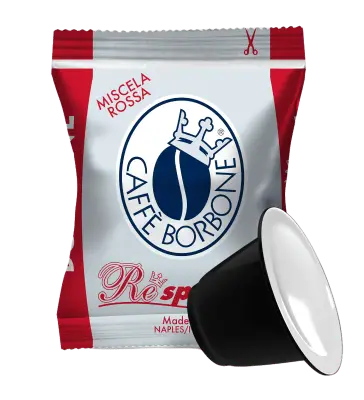 100 Capsules BORBONE Respresso RED Blend Nespresso Compatible
21,90 €


 100 Maracatú Coffee Capsules Gran Crema Uno System Compatible
19,90 €
 100 Capsules Maracatú Decaffeinated Uno System Compatible
23,90 €

More on this topic
More

Coffee Capsules Guide: How to Choose Your Perfect Taste
Read article


5 myths about capsule coffee
Read article
How to properly store coffee and coffee capsules: expert advice
Read article

Are you a reseller? Access the Maracatú B2B price list in just a few steps!
Read article
Capsule systems compared: Nespresso, Dolce Gusto, A Modo Mio, ESE and Caffitaly — which to choose
Read article

How to descale your coffee machine: a practical guide from over 15 years in coffee
Read article
Caffè Borbone: a guide to the Rossa, Nera, Blu, Oro and Dek blends
Read article

The coffee intensity scale: what the numbers on capsules really mean
Read article

The origins of coffee: myths, legends and the road to the Italian cup
Read article
Coffee roasting: the levels, and how each one changes the cup
Read article
Espresso: how the Italian classic was born
Read article

Water and the taste of coffee: the ingredient nobody talks about
Read article