





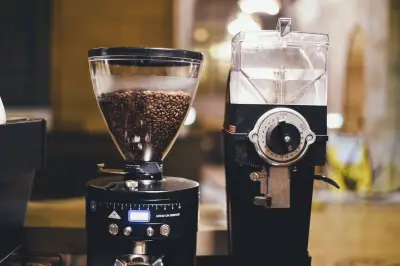
How to choose a coffee grinder: manual or electric
Why the grinder matters more than it seems
Anyone moving from ground coffee to beans faces a choice that usually comes last: the grinder. Yet it decides how much of that bean actually reaches the cup.
The principle is familiar: a whole bean holds its aroma for a long time, ground coffee loses it quickly. Grinding shortly before brewing is the most direct way to gain fragrance.
We have already written about grind size and how it changes extraction in our guide to grinding. Here we look at the tool itself: how it works, where designs differ and what to check before buying.
One clarification: if coffee at home comes only from Nespresso®, Dolce Gusto®, A Modo Mio® or Caffitaly® capsules, a grinder is not needed, because the dose was sealed at the factory. For every other method the question is worth asking.
Blades or burrs, conical or flat
A blade grinder works like a small blender: a blade spins fast and shatters the beans it meets. How fine the coffee ends up depends on how long the button is held, and fine dust sits in the jar beside still coarse fragments.
That is not a fault, it is simply how the system works. For the morning moka pot it can be enough. When a repeatable cup is the goal, though, particles of different sizes yield to the water at different speeds and the taste drifts from one day to the next.
A burr grinder follows another logic. Two toothed surfaces, one fixed and one rotating, crush the bean and push it through a calibrated gap. The distance between the burrs sets the particle size, and everything passes through the same opening.
Conical burrs are a cone turning inside a ring. They usually run at lower speed, warm the coffee little and are the usual choice in hand grinders and many electric kitchen grinders.
Flat burrs are two discs facing each other. They generally produce slightly more even particles and appear more often on models designed for espresso, with a harder working motor and more noise.
At home the difference between the two geometries weighs less than online debates suggest: build quality and precision of adjustment count for more.
Manual or electric: it depends on how many cups
The choice between crank and motor is not about quality. A good manual grinder and a good electric one carry comparable burrs; what changes is time, noise and who does the work.
A hand grinder is quiet and needs no socket. You feel the resistance of the beans in your hand, then the crank lightens as the chamber empties. For one morning cup the effort is brief, and many find it a pleasant ritual.
The limit arrives with quantity. Grinding for a large moka pot, or for the whole family on an evening with guests, becomes real work by hand. At the fine setting espresso needs, the crank turns harder and the arm notices.
An electric grinder takes care of all this: set the dose, press a button and meanwhile warm the cup or froth the milk for a cappuccino. In return it asks for counter space, some noise and more careful cleaning.
The rule we give at the counter is practical. One or two cups a day, a small moka pot or a pour-over: a hand grinder is plenty. Daily espresso, more people in the house or a machine that wants a fine, always identical grind: electric is the better path.
Adjustment, static and the coffee that stays inside
Some grinders adjust in steps: a click, and the burr moves a fixed distance. Others are stepless: no notches, the ring turns freely. Steps are easy to repeat; a stepless system allows the smallest corrections.
Brewing methods do not demand the same precision. For the moka pot and the French press a fairly wide window works and a coarse step does no harm. Espresso lives in a narrow band: one notch either way changes the extraction time and the look of the crema. A grinder meant for espresso therefore has to move in very small steps in the fine zone, or the right point gets skipped and never hit.
Two everyday nuisances deserve a mention before buying. The first is static: freshly ground coffee picks up a charge and clings to the container walls, or jumps out when it is opened. A widespread trick is to stir the beans with a dampened teaspoon handle before grinding; on hand grinders the effect is usually milder.
The second is retention: part of the grounds stays between the burrs and in the exit chute and lands in the next cup, already stale. Short, straight paths hold back less. With our coffee beans the advice is to grind only the dose needed.
Care, cleaning and the shopping checklist
Coffee oils settle on the burrs and turn rancid over time. A neglected grinder is tasted in the cup before it is seen inside: a flat, slightly stale aftertaste that no new blend corrects.
Routine cleaning is simple. A dry brush for the burrs and the chute, a cloth for the container, no water on metal parts that will not dry properly afterwards.
There are also cleaning pellets to be ground like beans: useful now and then, but no replacement for the brush. Among our accessories there are suitable brushes and containers.
When comparing two models, look at the following. That there are burrs, not blades. What the burrs are made of, steel or ceramic, both valid when well made. That the adjustment covers the methods you use, with small steps in the fine zone if espresso is in the picture. How much coffee stays inside after use. How easily the chamber opens and the upper burr comes out for cleaning, ideally without tools. And how loud it is: an electric grinder that wakes the house at dawn soon becomes an ornament.
If you are unsure where to start, tell us how you brew and for how many people. Get in touch: the Maracatú team will gladly reply with a tailored suggestion.
Popular products
All products
More


 100 Maracatú Coffee Capsules Gran Crema Uno System Compatible
19,90 €


 100 Capsules Maracatú Decaffeinated Uno System Compatible
23,90 €
 80 Maracatú Coffee Capsules Gran Crema Lavazza Blue In Black Compatible
18,90 €



More on this topic
More

Coffee Capsules Guide: How to Choose Your Perfect Taste
Read article


5 myths about capsule coffee
Read article
How to properly store coffee and coffee capsules: expert advice
Read article

How to descale your coffee machine: a practical guide from over 15 years in coffee
Read article

Capsule systems compared: Nespresso, Dolce Gusto, A Modo Mio, ESE and Caffitaly — which to choose
Read article
Caffè Borbone: a guide to the Rossa, Nera, Blu, Oro and Dek blends
Read article

The coffee intensity scale: what the numbers on capsules really mean
Read article

Are you a reseller? Access the Maracatú B2B price list in just a few steps!
Read article

The origins of coffee: myths, legends and the road to the Italian cup
Read article
Coffee roasting: the levels, and how each one changes the cup
Read article
Espresso: how the Italian classic was born
Read article

Water and the taste of coffee: the ingredient nobody talks about
Read article