


Coffee and art: the cup as a source of inspiration
Coffee and art: when the cup becomes a source of inspiration
A cup on the table, steam rising from the surface, light coming in from the window: it takes very little to imagine a small scene to paint.
It is no accident that coffee and the places where it is drunk have appeared so many times in art.
The warm colours, the shapes of small objects and the atmosphere of cafés offer plenty of inspiration to painters, photographers and illustrators.
And you do not have to be an artist to feel inspired: anyone who simply likes to observe can learn to look at the cup with different eyes.
In this guide we look at how coffee and cafés appear in some famous paintings and how these places have been meeting points for artists.
We will then talk about the design of the moka and the cup, about the drawings on the foam in latte art and about a technique to try at home: painting with coffee.
Whether you love painting, drawing or simple curiosity, there is always something to discover around a cup.
Cafés in the most famous paintings
Among the many paintings that portray life in cafés and bars, some have entered the collective imagination.
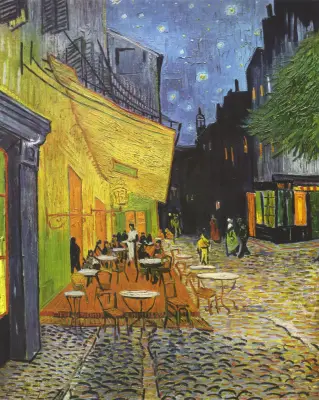
One of the best known is Café Terrace at Night by Vincent van Gogh, painted during his stay in Arles.
The picture shows the terrace of a café lit by a lamp, with tables outdoors and a starry sky in the background.
The warm yellow of the light contrasts with the deep blue of the night and immediately gives the idea of a welcoming place.
A very different atmosphere can be found in Nighthawks by Edward Hopper, one of the most celebrated paintings of American art.
The scene shows a diner open at night, seen through large windows, with a few customers sitting at the counter.
A few elements, such as the counter, the people and the light, are enough to build the whole scene.
The artificial light inside and the empty street outside give the picture a quiet, contained atmosphere.
Many illustrations and advertising posters have also told the story of coffee, with steaming cups and beans drawn in a simple, recognisable way.
In these images the cup often becomes a symbol of a break, a moment of warmth or company.
Looking at these works is a good way to notice how much light, colours and small details contribute to the atmosphere of a break.
Artists in cafés: places of meeting and ideas
Besides appearing in paintings, cafés have long been places frequented by artists.
A small table, a cup and a little time to spare made it possible to discuss ideas, show sketches to friends and meet other creative people.
In many European countries, historic cafés are still linked today to the painters, sculptors and writers who used to visit them.
Part of this story concerns literary cafés: you can read our article on coffee and books: the Italian literary cafés.
Even today some venues host exhibitions and small displays dedicated to local artists.
With a cup in your hand it is easy to stop and look at a picture hanging on the wall or to leaf through a sketchbook.
Some artists use cafés as an improvised studio, where they can draw from life without needing much material.
For many people, carrying a notebook is a simple habit: a few minutes are enough to sketch what is in front of you.
It might be a person at the next table, the cup with its saucer or the light falling on a counter.
Coffee thus becomes an opportunity to observe more attentively the people, the objects and the light around us.
The design of the moka and the cup
Some objects linked to coffee have become so familiar that they can be recognised from their outline alone.
This is the case of the moka, with its octagonal body and geometric lines that can be recognised at first sight.
The materials contribute too: the metallic surface reflects the light and makes the moka unmistakable on the stove.
For many people it is an object tied to the home and to family habits, so much so that it often appears in photographs, illustrations and decorations.
If you like this object, you can discover the products of the brand Bialetti, one of the best-known names in the Italian tradition of home coffee.
The cup has an aesthetic of its own too: its shape, the thickness of the ceramic, the colour and the decoration change the look of the drink.
A white cup brings out the colour of the espresso, while a decorated one can become a small collector's item.
We have explored the subject in our article on why the coffee cup matters.
In our accessories and cups section you will find several options in different shapes, colours and materials.
A biscuit or a chocolate beside the cup completes the scene: in our delights and sugar section you will find several specialities to go with coffee.
Choosing the object you like best is a simple way to make the break more personal.
Latte art: drawing on the foam
Latte art is the art of creating small drawings on the surface of a cappuccino by pouring frothed milk into the espresso.
The best-known patterns are the heart, the leaf and the tulip, but with practice more elaborate shapes can be achieved too.
To get a drawing you need a soft, even foam and an espresso with a good crema, which provides the base for the colour contrast.
The gesture is the most important part: the movement with which the milk is poured decides the shape that will appear on the surface.
Beginners can try a few simple shapes and accept that the first attempts need not be perfect.
There is also a more accessible variant: drawing on the foam with a toothpick, gently moving a little crema or chocolate.
Another simple way is to dust some bitter cocoa over the foam, even through a perforated paper stencil, to create a pattern.
A well-decorated cappuccino is also an excellent photographic subject: you can read our guide on how to photograph coffee at home.
To start from a good base, in our coffee beans and ground coffee section you will find several blends suited to espresso.
Making a decorated cappuccino for guests is also a way of welcoming them with a small creative gesture.
Painting with coffee: a technique to try at home
Coffee is not just a drink: it can also become a colour.
Diluted with water, it gives tones ranging from beige to dark brown, similar to sepia.
Many enthusiasts use it like a watercolour, with a brush and a sheet of thick paper suited to water.
Those who love drawing can also try a dip pen or a wooden stick dipped in the coffee.
You can prepare a more concentrated coffee and a lighter one, so as to obtain different shades in the same drawing.
Overlapping layers make the colour progressively darker, and letting each layer dry before the next helps to control the result.
For a decorative effect, some people also use the circular rings left by a wet cup placed on the sheet.
Coffee is a natural colour that can fade over time and with light, so it is best to keep the finished works away from the sun.
It is an activity suited to a quiet afternoon, alone or in company: a little leftover coffee and a sheet of paper are enough.
If you involve children, remember that coffee easily stains clothes and surfaces.
After all, a cup on the table, the light from the window and a little curiosity are already a good starting point for feeling inspired, whether you want to paint, photograph or simply observe.
If you are looking for cups, accessories or blends for your creative breaks, contact us: the Maracatú team is always happy to help you choose.
Popular products
All products
More


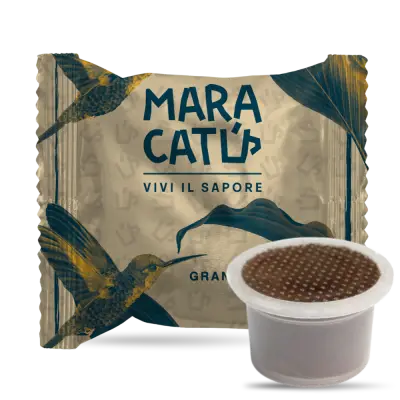 100 Maracatú Coffee Capsules Gran Crema Uno System Compatible
19,90 €


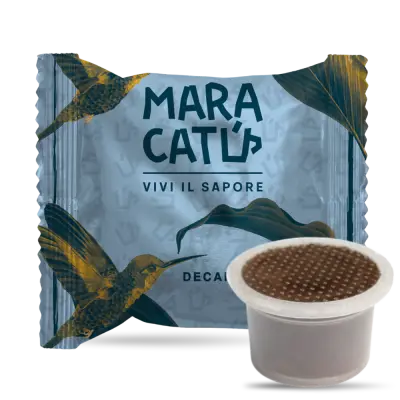 100 Capsules Maracatú Decaffeinated Uno System Compatible
23,90 €
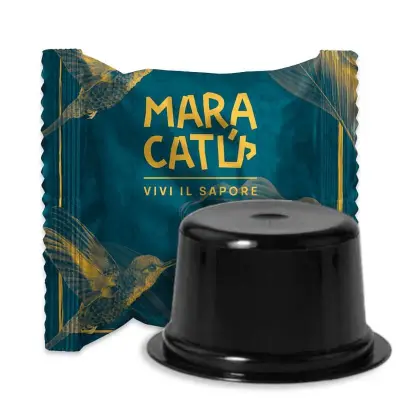 80 Maracatú Coffee Capsules Gran Crema Lavazza Blue In Black Compatible
18,90 €


More on this topic
More

Coffee Capsules Guide: How to Choose Your Perfect Taste
Read article


5 myths about capsule coffee
Read article
How to properly store coffee and coffee capsules: expert advice
Read article

How to descale your coffee machine: a practical guide from over 15 years in coffee
Read article
Capsule systems compared: Nespresso, Dolce Gusto, A Modo Mio, ESE and Caffitaly — which to choose
Read article

Caffè Borbone: a guide to the Rossa, Nera, Blu, Oro and Dek blends
Read article
The coffee intensity scale: what the numbers on capsules really mean
Read article

Are you a reseller? Access the Maracatú B2B price list in just a few steps!
Read article
The origins of coffee: myths, legends and the road to the Italian cup
Read article
Coffee roasting: the levels, and how each one changes the cup
Read article
Espresso: how the Italian classic was born
Read article
Water and the taste of coffee: the ingredient nobody talks about
Read article