





The cup is not a detail: shape, thickness and temperature
An experiment anyone can run
Brew two identical coffees and pour them into two different cups: one of thick ceramic, rinsed first with hot water, and one thin one taken from the cupboard.
Taste them a few seconds apart. In most cases the difference is immediately obvious, and it is not suggestion.
The reason is mundane, which is why it goes unnoticed. An espresso occupies twenty-five to thirty millilitres. That is a small enough volume that any cold surface it touches draws heat from it perceptibly, and temperature is the variable deciding which aromas reach the nose and which do not.
The cup is the last link in a chain we have paid attention to everywhere else: blend, grind, dose, pressure, water. Then the coffee lands in an object chosen twenty years ago because it matched the tea service.
Thickness governs temperature
An espresso leaves the group head hot and cools quickly, because the volume is tiny and the surface relatively large.
Thick ceramic stores heat and releases it slowly, so the drink stays in the right window for a few seconds longer. A thin wall does the opposite: to warm itself it takes heat from the coffee, and the temperature drops at once.
This is where the bar habit of keeping cups on top of the machine comes from. It is not for show. A cup at room temperature reaches the table already at a disadvantage, and the difference shows most on the finish, where the sweet notes give way to something drier.
At home you do not need a cup warmer. Rinsing them with hot water and turning them over a moment before brewing is plenty. Anyone with a machine that has a metal top plate can simply leave them there between coffees.
The reverse also holds, and we often forget it: a cup taken straight from a dishwasher that has just finished is hot enough to scorch the most delicate notes. Warm is right, scalding is not.
Shape decides where the crema goes
The inside of an espresso cup is rounded and narrow at the base for a precise reason: the stream falling from the portafilter is gathered in the centre and stirred rather than splashed across a flat surface.
The result is a more even crema that closes over the surface instead of breaking into patches. In a wide, flat-bottomed cup the same crema spreads, thins and disappears before it reaches the lips.
The rim matters as much as the base, though it is rarely considered. A thin rim sits better and delivers the liquid in a narrow stream, closer to the centre of the tongue, where sweetness and body register best. A very thick rim spreads the flow towards the sides, where acidity is felt more.
The interior colour has a less technical but real effect: against a white wall the crema is readable, and you can see whether it is compact or has already collapsed. That is why almost every professional cup is white inside, whatever is happening outside.
Porcelain, stoneware or glass
The material is not an aesthetic detail, because it changes both how well the cup holds heat and how it ages.
Porcelain is fired at high temperature and comes out dense and barely porous. It holds heat well even with relatively thin walls, does not absorb odours and does not stain. That is why it remains the standard in bars.
Stoneware usually has thicker walls and greater thermal mass, so it keeps heat longer. In exchange it is heavier, and the inside is often glazed in colour, which makes the crema harder to read.
Glass has obvious appeal for layered drinks, where you want to see milk and coffee separately. For espresso, though, it is the worst choice in temperature terms unless it is double-walled: there the air between the layers acts as insulation and the result is excellent.
One last practical note, true for every material: heavily used cups develop micro-scratches inside and over time hold oily residue that alters the taste. A periodic cycle with a cleaner made for coffee equipment fixes it, and that is not the same as ordinary washing up.
The sizes that actually matter
Capacities are not arbitrary, and getting them wrong is the most common mistake we see.
For espresso the cup is generally between sixty and ninety millilitres in total capacity, to hold twenty-five or thirty millilitres of drink. It looks disproportionate, but that empty space has a job: it traps the aromas above the crema and channels them towards the nose as you drink.
An oversized cup disperses those aromas and makes a coffee look meagre when it is not. An undersized one pushes the crema over the rim.
For cappuccino you move up to a hundred and fifty or a hundred and eighty millilitres, with a more open shape that leaves room for foam and allows it to be drawn on. Using a cappuccino cup for an espresso is the quickest way to ruin it.
For moka coffee the logic is the same as espresso with a few millilitres more, because the extraction is less concentrated and the volume in the cup slightly larger.
How to choose without overthinking
Three criteria are enough, and you can check them in a shop in thirty seconds.
Pick it up and feel the weight. For espresso you want ceramic with some heft, because weight here means thermal mass.
Look inside, against the habit of looking at the outside. The base should narrow towards the centre and the interior should be pale.
Check the capacity by filling it with water if you can. A cup that looks right by eye is often larger than necessary.
The rest is personal taste, and the accessories and cups section has plenty of choice. If you brew mostly in a moka the same rules apply with slightly more capacity, and if you use a capsule or pod system it is better to start from the volume the machine delivers rather than from looks.
One last thing we see often and that costs nothing to fix: perfect cups used cold. It is the easiest waste to avoid in the whole chain, and it takes five seconds of hot water.
If you are unsure which size suits your machine, contact us. The Maracatú team is here to help.
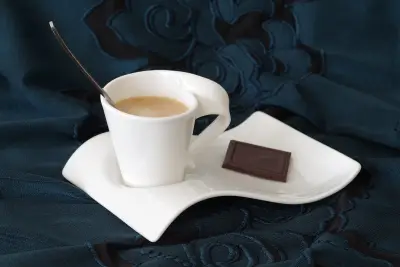
Image: porcelain espresso cup, Balise42, CC BY-SA 4.0 (Wikimedia Commons).
Popular products
All products
More


 100 Capsules BORBONE Respresso RED Blend Nespresso Compatible
21,90 €


-webp_sm.webp)
-webp_sm.webp)
 100 Maracatú Coffee Capsules INTENSO Uno System Compatible
19,90 €
 100 Maracatú Coffee Capsules Gran Crema Uno System Compatible
19,90 €
 100 Capsules Maracatú Decaffeinated Uno System Compatible
23,90 €
 80 Maracatú Coffee Capsules Gran Crema Lavazza Blue In Black Compatible
18,90 €

 16 Coffee Capsules Nescafè Dolce Gusto Espresso ARDENZA
4,99 €

More on this topic
More

Coffee Capsules Guide: How to Choose Your Perfect Taste
Read article


5 myths about capsule coffee
Read article
How to properly store coffee and coffee capsules: expert advice
Read article

Are you a reseller? Access the Maracatú B2B price list in just a few steps!
Read article

Capsule systems compared: Nespresso, Dolce Gusto, A Modo Mio, ESE and Caffitaly — which to choose
Read article

How to descale your coffee machine: a practical guide from over 15 years in coffee
Read article

Caffè Borbone: a guide to the Rossa, Nera, Blu, Oro and Dek blends
Read article
The coffee intensity scale: what the numbers on capsules really mean
Read article

The origins of coffee: myths, legends and the road to the Italian cup
Read article
Coffee roasting: the levels, and how each one changes the cup
Read article
Espresso: how the Italian classic was born
Read article

Water and the taste of coffee: the ingredient nobody talks about
Read article